
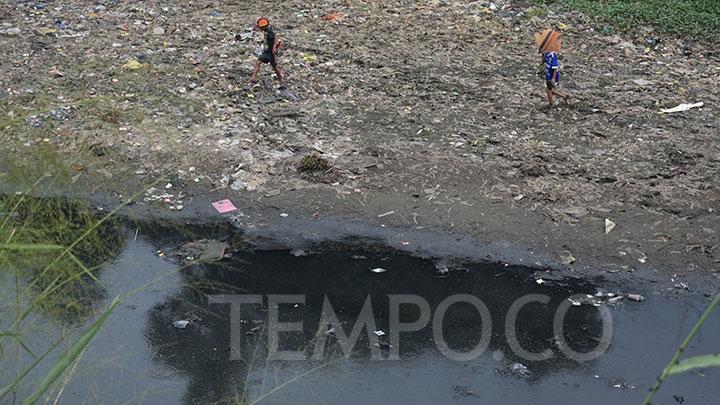
TEMPO.CO, Jakarta - For nearly two years, Hasbiah has stopped using water from the Oko-Oko River. The 45-year-old woman, who has lived for the past four years in Lamedai village, Tanggetada subdistrict, Kolaka Regency, Southeast Sulawesi, said she has witnessed firsthand the transformation of a river once commonly used for bathing and drinking. The water of the Oko-Oko River now runs red because of pollution from brick-colored sediment lining the riverbed.
The Oko-Oko River flows along the border between Lamedai and Oko-Oko villages in Pomalaa subdistrict. In those two villages, along with 11 others in the subdistricts of Pomalaa, Baula, and Tanggetada, the Indonesia Pomalaa Industrial Park (IPIP) industrial zone is rapidly expanding. Piles of earth from newly cleared land for IPIP’s nickel smelter are suspected of being washed by rainwater into the Oko-Oko River.
Hasbiah’s home stands only a stone’s throw from the riverbank. During scorching dry weather, the river appears yellowish-red, with water levels reaching an adult’s calves. But when rain falls, within an hour the water turns brick red and the river level rises sharply. “The quality of the river water has deteriorated over the past year,” Hasbiah said at her home on Sunday, April 26, 2026.
Hasbiah fears the risk of flash floods that could strike her house at any moment. Her anxiety has deepened since construction began on the nickel smelter, which she worries may eventually encroach on her two-hectare clove plantation. The plantation lies less than two kilometers from the IPIP expansion site.



















:strip_icc():format(jpeg)/kly-media-production/medias/5220347/original/094913800_1747281277-41961081_8976420.jpg)
:strip_icc():format(jpeg)/kly-media-production/medias/5582904/original/095301300_1778131421-cpns_bea_cukai_-_cek_fakta.jpg)
:strip_icc():format(jpeg)/kly-media-production/medias/4576168/original/048568900_1694732112-20230915022441__fpdl.in__medium-shot-woman-posing-with-flowers_23-2150725596_normal.jpg)
:strip_icc():format(jpeg)/kly-media-production/medias/5525602/original/003097400_1773046669-unnamed__54_.jpg)
:strip_icc():format(jpeg)/kly-media-production/medias/5572218/original/060707400_1777780612-cek_fakta_-_CPNS_Kemenag.jpg)
:strip_icc():format(jpeg)/kly-media-production/medias/4442582/original/000568400_1685093803-Screenshot_20230526_120852_Gallery.jpg)
:strip_icc():format(jpeg)/kly-media-production/medias/5407521/original/093009600_1762744968-Cek_Fakta_Tidak_Benar_Ini_Link_Pendaftaran_-_2025-11-10T101330.228.jpg)
:strip_icc():format(jpeg)/kly-media-production/medias/3187033/original/003171100_1595400533-makkah-kaaba-hajj-muslims_21730-6508.jpg)
:strip_icc():format(jpeg)/kly-media-production/medias/5380783/original/022608800_1760432989-Ilustrasi_Qunut.jpg)
:strip_icc():format(jpeg)/kly-media-production/medias/5382328/original/091326000_1760578848-Cek_Fakta_Tidak_Benar_Ini_Link_Pendaftaran_-_2025-10-15T134632.180.jpg)
:strip_icc():format(jpeg)/kly-media-production/medias/4015150/original/070691700_1651836959-UMROH_BACKPAKER_3.jpg)
:strip_icc():format(jpeg)/kly-media-production/medias/4439341/original/074219600_1684915362-ibrahim-uz-3Z3RvzpVAqM-unsplash.jpg)
:strip_icc():format(jpeg)/kly-media-production/medias/2806807/original/084266200_1557976563-IMG-20190507-WA0082.jpg)
:strip_icc():format(jpeg)/kly-media-production/medias/5580670/original/061045400_1778126140-8a6419d8-418c-4e77-8846-31d68f6b6e38.jpg)
:strip_icc():format(jpeg)/kly-media-production/medias/5550896/original/089873500_1775711382-Cek_Fakta_Tidak_Benar_Ini_Link_Pendaftaran_-_2026-04-09T120454.556.jpg)
:strip_icc():format(jpeg)/kly-media-production/medias/4697748/original/031327300_1703490526-20231225-Taman-Margasatwa-Ragunan-Herman-5.jpg)
:strip_icc():format(jpeg)/kly-media-production/medias/4020490/original/041535400_1652339052-20220512-Aksi-Buruh-Peringati-Mayday-7.jpg)
:strip_icc():format(jpeg)/kly-media-production/medias/3081754/original/022995900_1584692954-20200320-Suasana-Salat-Jumat-di--Masjid-Agung-Al-Azhar-Jakarta-1.jpg)